
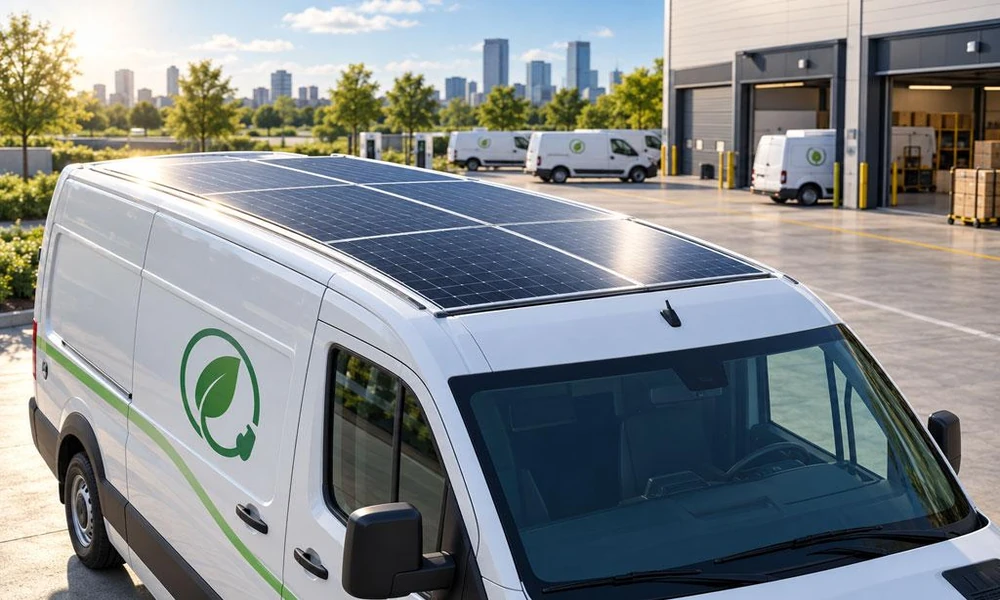
Electric delivery vehicles offer an interesting setting for onboard solar generation. Their roofs can provide space for photovoltaic modules, while their routes create identifiable patterns of driving, parking, and energy use. Turning that space into a practical system requires coordination between the vehicle body, electrical architecture, module design, and production process. Encapsulation materials are part of that coordination from an early stage.
The technical concept has been demonstrated in commercial vehicles. In the Lade-PV project, Fraunhofer and its partners developed photovoltaic modules and power electronics for an electric truck, feeding roof-generated electricity into the vehicle’s onboard system. The project provides a useful reference for integration feasibility, although another fleet’s energy contribution must be calculated from its own operating conditions.
A delivery fleet should begin by defining where the electricity will go. Charging a traction battery and supporting auxiliary equipment involve different system decisions. The team should also document depot shading, route schedules, parking locations, and seasonal use. These inputs establish the value the roof system could deliver and prevent the module specification from being driven by nominal wattage alone.
Available roof area must then be translated into a buildable layout. Equipment, drainage features, body joints, curvature, and service access may limit the usable surface. Designers should compare a single large laminate with several smaller sections. That choice affects electrical grouping, handling, replacement, manufacturing equipment, and the amount of perimeter that needs protection.
Encapsulation development should follow the selected layout. A large laminate needs consistent film placement and bonding across its entire area. The team should examine interconnect coverage, trapped air, alignment, and local thickness changes. Smaller laboratory coupons help screen materials, but a representative roof section is needed to understand whether those results carry over to the intended manufacturing scale.
EPE solar film uses an EVA/POE/EVA co-extruded structure. Its outer and central layers are intended to combine processing and adhesion characteristics with moisture and electrical performance. For a delivery-vehicle module program, this provides a candidate architecture to examine through matched trials on the proposed front and rear substrates.
POE solar film provides a second candidate for comparison. The trial should use a defined grade and thickness, with processing conditions appropriate to that product. Comparing finished laminate behavior gives a more useful result than comparing resin-family descriptions. The development team can then weigh material performance alongside cycle time, handling requirements, scrap, and repeatability.
Process mapping is particularly valuable when the panel dimensions increase. Engineers should check the temperature history at several positions, examine vacuum effectiveness, and assess bonding at both the center and perimeter. Sampling should include areas around cell gaps, interconnections, and geometry changes. Recording those locations allows subsequent defects to be traced back to a specific part of the process.
The installed roof assembly also needs its own evaluation. Body movement, attachment stiffness, wiring routes, and access requirements can affect the design after lamination is complete. A review should identify which loads the module is expected to carry and how the mounting system transfers them. Encapsulation selection cannot resolve an undefined mechanical connection between the panel and the vehicle.
Validation requirements should be agreed with the vehicle partner early. The U.S. Department of Energy’s vehicle-PV consultation reported that environmental and electrical standards used in commercial vehicles are often included in validation programs. That reinforces the need to connect photovoltaic testing with the requirements of the intended vehicle platform.
Fleet economics introduce considerations beyond material price. A damaged roof section may require workshop time, spare parts, and interruption to delivery operations. A modular layout could simplify some repairs, while a larger integrated panel may offer other design advantages. These alternatives should be compared using a realistic service procedure, including diagnosis, removal, replacement, and final electrical checks.
Production records should make that service process easier. Linking film batches, laminate settings, inspection results, and module serial numbers creates a basis for investigating field issues. Before launch, manufacturers can establish acceptance criteria for appearance, electrical output, and relevant bond measurements. A controlled pilot fleet can then provide operating evidence before the design is adopted more widely.
Vehicle weight should be tracked throughout this process. The module, attachment system, cabling, and power electronics all contribute to the installed mass. Comparing encapsulant options within a complete bill of materials helps prevent a local improvement from obscuring a less favorable overall design. The same review can identify handling constraints during assembly.
For teams considering EPE and POE films, the next practical step is a representative trial specification. It should define the roof geometry, adjacent materials, electrical configuration, process limits, and validation targets. Building that specification together helps convert the promise of a solar delivery roof into a product whose manufacturing quality and service requirements can be assessed.
